- Product Details
- Order Numbers
- Literature
- Coupons
- FAQ
Finally, A Varnish That Smoothes Out Your Stickiest Problem
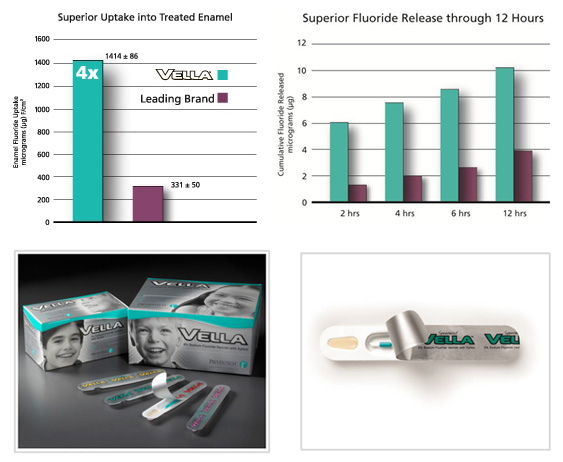
Tired of lumps and clumps slowing down your varnish application? Try Vella, the 5% sodium fluoride varnish with Xylitol that goes on easier. With twice as many bristles, our brush applies more product faster. And our container is so sturdy you can hold it closer to the mouth and wipe the brush tip more easily. That means fewer trips to the well, ensuring a smoother, less-messy, thin-layer application. With unsurpassed fluoride uptake!
Plus, Vella has been dramatically whitened to VITA® A1-B1 and quickly dries clear in contact with saliva, allowing you to provide a
fluoride treatment that leaves no trace. Available in strawberry, spearmint or delicious melon. The switch is on. Ask your dealer for Vella for dispensing to your patients or call us at 1-800-474-8681 and we'll immediately ship your order in your dealer's name.
Frequently Asked Questions
Q
What is Fluoride Varnish?
A
Most Fluoride varnishes are lacquers containing 5% fluoride in a colophony/resin base. Fluoride varnish provides a highly concentrated, temporary dose of fluoride to the tooth surface. The varnish holds the fluoride close to the tooth surface for a longer period of time than other concentrated fluoride products. Unlike low dose fluorides available over the counter such as fluoride toothpaste, highly concentrated fluoride products such as fluoride varnish must be applied by a dental professional.
Q
How does Fluorides prevent dental decay?
A
For all tooth surfaces, there is a continuous cycle of demineralization and remineralization of tooth enamel. Tooth decay (dental caries) is an infectious, transmissible disease caused by bacteria colonizing on the teeth and producing acid that dissolves enamel, resulting in greater demineralization. All fluorides act to slow demineralization and boost remineralization. Fluorides work in at least four different ways to protect teeth from tooth decay. Fluoride is incorporated in tooth structure when small amounts are swallowed daily while teeth are forming. Fluoride becomes concentrated in the outer enamel surfaces when applied topically after the teeth erupt. Dental plaque and saliva act as fluoride reservoirs to enhance the remineralization process. In addition, fluorides interfere with the decay-causing bacteria colonizing on teeth and reduce their acid production, thus slowing demineralization.
Q
What are the advantages of Fluoride Varnish over other professionally applied fluorides?
A
Fluoride varnish works by increasing the concentration of fluoride in the outer surface of teeth, thereby enhancing fluoride uptake during the early stages of demineralization. The varnish hardens on the tooth as soon as it contacts saliva, allowing the high concentration of fluoride to be in contact with tooth enamel for an extended period of time. (About 7-10 days).
Inadvertent ingestion of a high dose of fluoride with varnish application is less likely than with other highly concentrated fluoride products. This is important in younger patients. Fluoride varnish is quickly and easily applied which is especially helpful for treating infants and toddlers who may have difficulty tolerating the tray technique due to their gag reflexes.
Q
Are Fluoride Varnishes FDA approved?
A
Fluoride varnishes are approved as Class II Medical Devices ( FDA 510 K compliance) for use as a cavity liner and/or tooth desensitizer. Fluoride varnishes is not FDA approved as caries preventive agents. They are used “off-label” for preventing dental caries. FDA approval is not required to use fluoride varnish off-label. (USFDA, 1998, USP DI, 2006) Many medications are currently prescribed and administered for off-label use, and many drugs used in medical practice for children have never been tested in children. The FDA regulation states: “Good medical practice and the best interests of the patient require that physicians use legally available drugs, biologics and devices according to their best knowledge and judgment. If physicians use a product for an indication not in the approved labeling, they have the responsibility to be well informed about the product, to base its use on firm scientific rationale and on sound medical evidence, and to maintain records of the products use and effects.” (USFDA, 1998; AAP, 2002)
Q
What is the ADA’s position on Fluoride Varnish?
A
The ADA Council on Scientific Affairs states: “Fluoride varnish applied every six months is effective in preventing caries in the primary and permanent dentition of children and adolescents.” They further state that Fluoride varnish creates less patient discomfort and achieves greater patient acceptance than fluoride gel, especially in preschool-aged children. Two or more applications of fluoride varnish per year are effective at preventing caries in high-risk populations.
Q
Does Fluoride Varnish contribute to Fluorosis?
A
The Fluoride varnish (with peak plasma levels less than a daily fluoride tablet or brushing with fluoride toothpaste) applied infrequently (two to four times a year at 3-6 moth intervals) is unlikely to contribute to fluorosis in children under age six. (Ekstrand, Koch, Petersson, 1980)
Q
How long does it take to complete a Fluoride Varnish application on most patients?
A
An experienced dental hygienist can complete a complete full mouth fluoride varnish application in about one minute. Treatment time variables include: patient acceptance (squirminess) and type of applicator brush or delivery system used. The viscosity of the varnish material can also affect the application time. In most all cases though, it’s only a minute or two in the worst case.
Q
Do I have to be concerned about pine nut allergies with 5% Sodium Fluoride Varnish?
A
The resin/rosin used in Vella Varnish is extracted from pine stump wood and not collected from living trees, therefore does not contain tree sap. This source combined with further synthesis during the manufacturing process greatly reduces any adverse reaction to rosin products due to tree nut allergies. However, as with any medical issue, patients should consult with his/her health care provider.
Q
Are Fluoride Varnishes, like fluoride gel treatments, covered by dental insurance?
A
The only correct answer is that it totally depends on the patient’s policy. There is a new fluoride varnish code added by the CDT 2007-2008, code 1206 (fluoride varnish), but it is only reimbursed for documented high-risk patients. This is defined as patients with a history of caries or hypersensitivity. There are no age restrictions with code 1206. For routine topical fluoride treatment in children under 12, code 1203 (child fluoride) historically used for fluoride gel tray procedures, is generally accepted by insurance providers. If questioned, patient risk does come into question and reimbursement may not be allowable without additional supporting documentation. For caries prevention on adult patients, code 1204 (adult fluoride) can be used but is rarely reimbursed without a patient risk assessment narrative. Hence the low number of adult fluoride treatments. For patient hypersensitivity related to scaling and root planing or surgical procedures, code 1206 should be used along with thorough high-risk patient documentation to ensure reimbursement. This information should be documented in the ADA Dental Claim Form Box 35 (Remarks) used to describe medical necessity. Allowable high-risk medical necessities include: Patient diagnosed with diabetes, high caries risk, SRP sensitivity, pregnancy and high-risk Diagnodent® readings. Because of the increasing popularity of fluoride varnish most dental offices are already knowledgeable as to which patient insurance plans cover specific codes. Rather than re-create the wheel it’s best to plug into what they’re already doing and offer the above advice if reimbursement problems occur.

From prophy pastes to disposable prophy angles to fluoride varnishes, Preventech has the products your practice needs to keep your patients happy and smiling bright!
Our Preventive Dental Care Products are
Made in the USA